
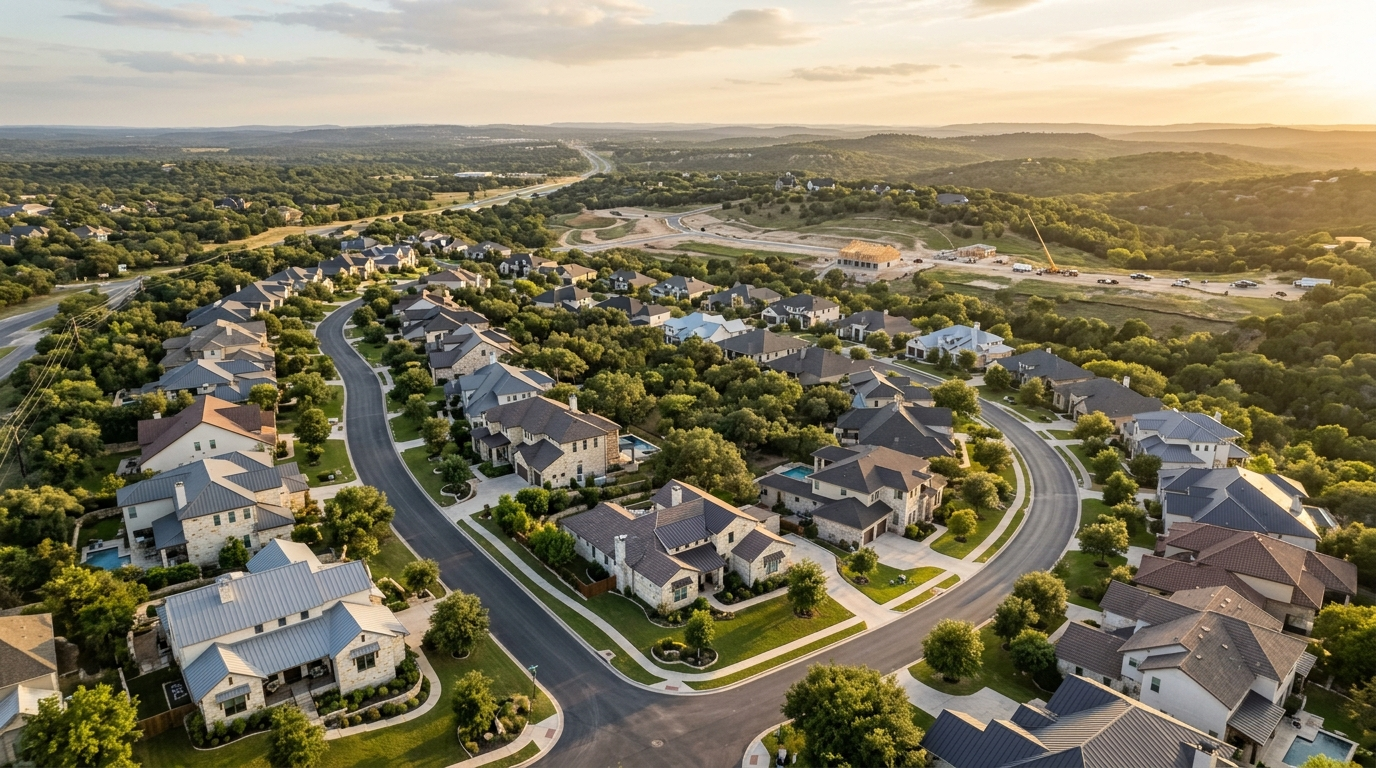
What will happen to Texas Hill Country home prices in 2026?
Quick Answer
Texas Hill Country home prices are more likely to stay flat or move modestly than surge in 2026. Texas Real Estate Research Center data showed the statewide median price down 1 percent year over year in February, while active inventory reached a 4.8-month supply. New Braunfels is following the broader pattern of longer market times and more buyer choice, but results will vary sharply by neighborhood, condition, price band, and competition from builders. For expert updates, contact Cody Posey Real Estate.
Why are Texas Hill Country home prices cooling in 2026?
The simplest explanation is that supply has caught up with demand. Texas entered 2026 with elevated inventory, and the Texas Real Estate Research Center reported roughly 134,400 active listings statewide by the end of February, about 10 percent higher than a year earlier. A 4.8-month supply is not a crash signal. It does mean buyers have enough alternatives to compare homes, reject weak value, and negotiate when a listing has been sitting.
Affordability is the second force. Mortgage rates remain high enough that buyers are calculating the payment before they fall in love with the house. The Research Center's forecast called for a 6.0 to 6.4 percent 30-year fixed mortgage rate around September 2026, with significant uncertainty. A rate in that range may support more activity than the market saw at recent peaks, but it does not recreate the buying power of 2020 or 2021. Buyers may still need a price adjustment, seller-paid costs, or a different home type to make the monthly number work. Anyone comparing scenarios should run the payment through the New Braunfels mortgage calculator instead of judging affordability by price alone.
The third force is new construction. Around New Braunfels, the IH-35 corridor, FM 1101, Solms, Veramendi, and the broader Comal and Guadalupe County growth areas give buyers choices that many resale sellers underestimate. Builders can change incentives without changing the public base price. They may offer rate buydowns, closing-cost help, appliance packages, or lot premiums that change the buyer's effective cost. I hear sellers say, "That new home is listed higher than mine," but the buyer may be comparing monthly payment and cash to close, not just list price. That is why builder incentives in New Braunfels matter when pricing a resale home.
None of these conditions says every Hill Country property will decline. A well-positioned home with the right condition, lot, location, and price can still attract serious attention. The adjustment is that buyers no longer have to excuse every flaw. Sellers should expect the market to separate the best-positioned listings from the ones priced from memory.
What does the 2026 forecast mean for New Braunfels buyers?
Buyers have more room to compare, but waiting for a dramatic price drop is not automatically the best strategy. The Texas Real Estate Research Center forecast projected statewide single-family sales growth of about 2 percent and a median price increase of about 1.5 percent to $350,000 as improving activity absorbs some inventory. That is a statewide forecast, not a promise for New Braunfels. It does suggest the more likely path is a slow, uneven market rather than a broad collapse.
Your strongest advantage is selection. When homes take longer to sell, you can compare inspection condition, property-tax burden, HOA or PID costs, commute patterns, builder competition, and future resale appeal before writing an offer. A lower purchase price is useful, but it is not the only way to improve the deal. Depending on the property and seller, you may negotiate closing costs, repairs, a rate buydown, or personal property. The right structure depends on what your lender allows and what creates the best total cost for you.
New Braunfels is not one single price trend. A newer subdivision competing with active builders can behave differently from Gruene, an acreage property outside city limits, a river-oriented home, or an established neighborhood with little new supply. Even two homes at the same price can carry very different monthly costs because of tax jurisdictions, MUD or PID assessments, insurance, HOA dues, and maintenance. The local question is not, "Will Hill Country prices rise or fall?" It is, "What is this specific home competing against, and what will owning it cost me?"
I walk buyers through this comparison before we focus on negotiation. A stale listing can create an opening, but days on market alone do not prove the home is overpriced. It may have fallen out of contract, needed a repair, launched with poor photos, or already adjusted to the market. The 2026 New Braunfels buyer-versus-seller market outlook explains why negotiating power changes by property and price band. Your offer should respond to the evidence, not a broad headline.
Are you trying to decide whether your New Braunfels neighborhood is rising, flat, or losing ground?
I will compare your property or target area against current competition, recent sales, builder pressure, and the terms buyers are negotiating now.
Call Cody Posey Real Estate at 830.360.5569 · Get your custom market read
What does a flatter market mean for Hill Country sellers?
A flatter market makes the first two weeks more important, not less. Texas homes sold in an average of 82 days in February 2026, up from 74 days a year earlier, according to the Texas Real Estate Research Center. The same report found the median seller price cut among closed sales was $16,900, or 4.9 percent from the initial list price. Those statewide figures show the cost of testing the market too high and correcting after buyers have already moved on.
For a New Braunfels seller, pricing should start with the current competition, recent closed sales, pending activity when available, and the concessions needed to get deals closed. A comparable sale from six months ago may still be relevant, but it must be adjusted for what buyers can choose today. If a builder nearby is advertising a financing incentive, your resale may need to compete through price, condition, closing-cost flexibility, or features the new home does not offer. You do not have to copy the builder. You do have to understand the comparison happening on the buyer's spreadsheet.
This is the local misconception I correct most often: buyers do not pay extra because a seller needs a certain net or spent a certain amount on improvements. They pay for the home's value relative to the alternatives available now. Some improvements protect marketability without returning dollar for dollar. Other items, such as a tired roof, deferred exterior work, dated flooring, or an uninsurable condition, can reduce the buyer pool more than the repair estimate suggests. Before deciding whether to list as-is or prepare the property, compare the likely sale-price benefit against the cost, time, and buyer objections each repair may solve.
A useful 2026 forecast is not a single appreciation number. It is a pricing range with a plan for buyer response. I want sellers to know the likely value range, which homes buyers will compare, the objections we should solve before launch, and the point where a price change would become necessary. Your specific number depends on condition, location, timing, and competition. That is where a comp-backed New Braunfels home value analysis becomes more useful than a statewide forecast.
Will Texas Hill Country home prices rise later in 2026?
Modest improvement is possible if mortgage rates ease and sales activity strengthens, but a return to rapid pandemic-era appreciation is not the base case. The Texas Real Estate Research Center projected approximately 2 percent sales growth and 1.5 percent median-price growth for the statewide single-family market through summer 2026. It also described the uncertainty around interest rates as significant. That matters because a small rate change can affect the payment more than a small price change.
The April 2026 Texas Housing Insight report showed prices still softening year over year while inventory and market times remained elevated. That creates a mixed forecast: buyers may come back as affordability improves, but they will return to a market with more listings and stronger expectations about condition and value. Increased demand can stabilize prices without producing aggressive appreciation. In some Hill Country pockets, especially where supply is limited or a property offers a hard-to-replace feature, prices may hold better. In areas with heavy builder activity or many similar resales, competition may remain stronger.
Owners should also separate market value from equity. A home can be flat for a year while the owner continues paying down principal. A seller who bought several years ago may still have meaningful equity even if the current price is below an earlier online estimate. Conversely, a recent buyer may need a careful net sheet because agent compensation, title expenses, loan payoff, repairs, concessions, and moving costs all affect what remains after closing. Market direction matters, but the decision should be based on your actual proceeds and next move.
My practical forecast for New Braunfels and the nearby Hill Country is a market that rewards preparation. Buyers should use the greater selection to improve fit and terms. Sellers should price close to demonstrated value and make the property easy to choose. Nobody should make a 30-to-180-day decision from a Texas headline alone. A custom market read should compare your neighborhood, price band, competing new construction, property condition, and likely monthly payment for the next buyer.
How should you use the 2026 forecast?
- Define your 30-to-180-day decision, including the move date, payment target, expected sale proceeds, and any property that must sell first.
- Compare the specific New Braunfels or Hill Country submarket using current listings, recent sales, market time, concessions, taxes, and builder competition.
- Build a buyer offer plan or seller pricing plan with clear numbers, decision points, and room for the market to answer.
In Closing
If you're planning to buy or sell in New Braunfels or the Texas Hill Country in the next 3 to 6 months, the next step is not betting on a statewide forecast. It is getting a custom market read for the neighborhood, price band, and property type that affect your move.
I'll map the current competition, likely value or offer range, builder pressure, negotiation options, and the numbers that could change your decision, so you can move forward with a practical plan.
Ready to talk strategy? Cody Posey Real Estate at 830.360.5569.
Sources: Texas Real Estate Research Center: Texas Real Estate Forecast, 12 Months Ending Summer 2026 · Texas Real Estate Research Center: Texas Housing Insight, April 2026 · Texas Real Estate Research Center: Texas Housing Insight, February 2026 · Redfin: New Braunfels Housing Market