
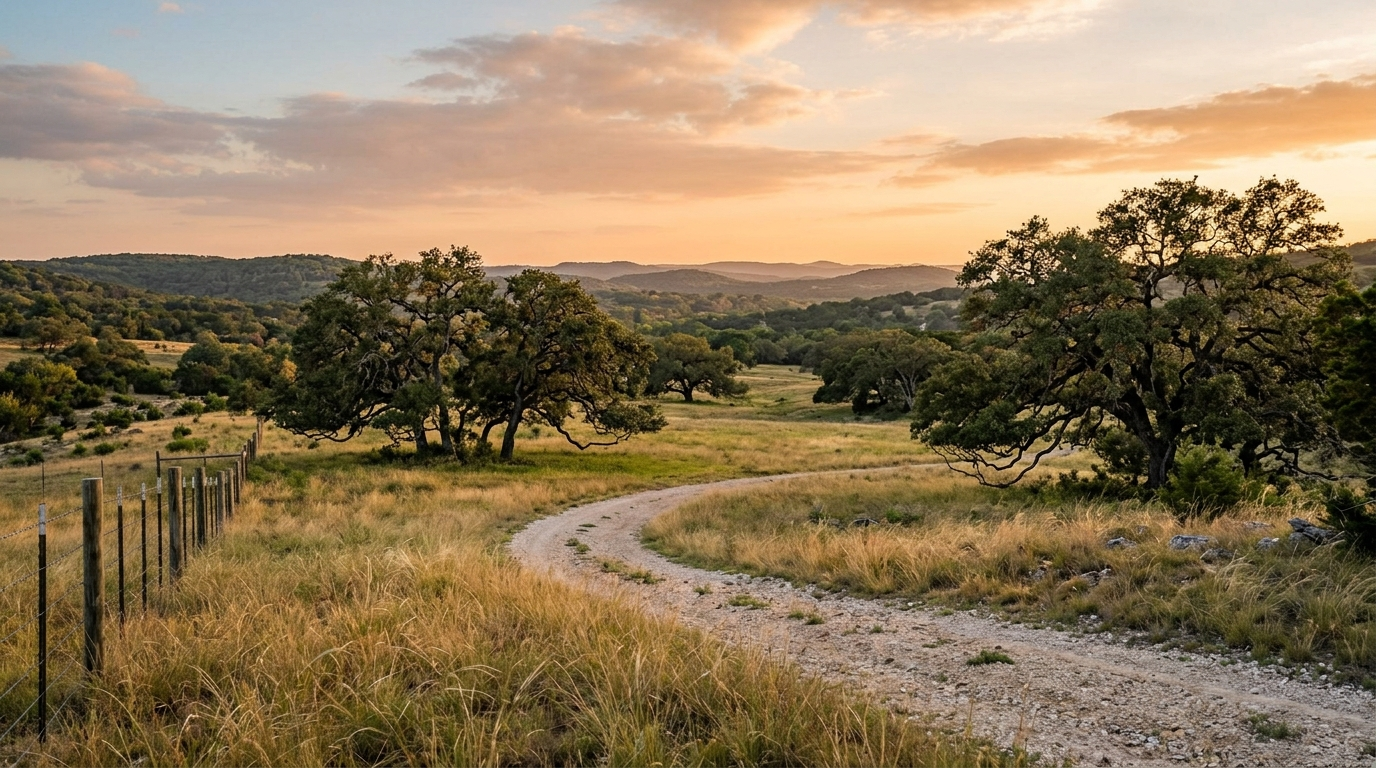
Is buying land in Fischer, TX a smart move in 2026?
Quick Answer
For buyers who want real Hill Country acreage within 30 minutes of New Braunfels, yes — Fischer, TX offers some of the best value in Comal County. One-acre homesites run roughly $85,000 to $115,000, while larger tracts of 10+ acres drop to about $30,000–$45,000 per acre, and you avoid city taxes entirely in the unincorporated county. Before you write an offer, verify water, septic feasibility, and deed restrictions — and contact Cody Posey Real Estate for a land tour with real numbers, not guesses.
What does land cost in Fischer, TX in 2026?
Fischer pricing breaks cleanly into three tiers, and understanding them keeps you from overpaying. Current inventory tells the story. At the entry level, one-acre homesites in gated communities — Summit Estates, Legends at Rancho del Lago — list from roughly $84,000 to $115,000 for 1 to 2 acres. That's $50,000–$85,000 per acre for the smallest slices, which is normal: small build-ready lots carry the highest per-acre premium because utilities, roads, and neighborhood restrictions are already sorted.
Step up to the middle tier and the math changes fast. Tracts in the 10–15 acre range list around $40,000–$45,000 per acre — a 15-acre tract near Canyon Lake recently listed at $599,900, and a 10.7-acre tract at $449,999. You get breathing room, elbow room for a shop or barn, and room for the kids to roam.
Then there's the true ranch tier: 75+ acres drops to roughly $28,000–$35,000 per acre. A 77-acre ranch tract off FM 32 listed at $2.5 million, and a 204-acre ranch at $5.6 million — big numbers, but the per-acre cost is less than half of the homesite tier.
Zoom out for context: the Texas Real Estate Research Center reports rural land prices in the Austin–Waco–Hill Country region hit a record high in Q2 2026, up 8.63% year over year, with statewide land plateauing around $5,218 per acre. Fischer sits well above that statewide median because you're paying for Comal County location — 30 minutes to New Braunfels, minutes to Canyon Lake — not just dirt. The key takeaway: prices are at record highs, but Fischer still prices well below Wimberley and the Lake Travis corridor, which is exactly why it's on buyers' radar.
Why are buyers choosing Fischer over Canyon Lake and Wimberley?
Fischer is unincorporated, which means no city property taxes and no municipal zoning — two things that matter more than most first-time land buyers expect. Your tax bill is county and school district only, and what you can build is governed by deed restrictions and county subdivision rules rather than a city planning department.
Location does the rest. Fischer sits along the Devil's Backbone (FM 32) corridor between New Braunfels and Wimberley, about 15 minutes from Canyon Lake and the Blanco River. You get the same Hill Country views and recreation access as the bigger-name towns, at a discount. Commuters reach New Braunfels in about 25–30 minutes, San Marcos in about 30, and San Antonio in roughly 50–60. For remote workers and weekend-ranch buyers, that's the sweet spot: far enough out to afford real acreage, close enough in for groceries and school runs.
There's also a scarcity angle. Fischer is a small unincorporated community — inventory is thin by nature, with roughly 50 active land listings at any given time, and most of those are under 10 acres. When a good 10–20 acre tract with views and no HOA hits the market, it doesn't sit. If you're comparing Fischer against Canyon Lake, the trade is simple: Canyon Lake gives you lake access and name recognition; Fischer gives you more land per dollar and fewer rules.
What should you verify before making an offer on Fischer land?
Land due diligence is a different animal than house due diligence, and skipping steps here is how buyers end up with an expensive paperweight. Run this checklist before you go under contract:
Deed restrictions and HOA. This is the single biggest variable in Fischer. Gated communities like Summit Estates protect your investment with restrictions on minimum build standards — but they'll also limit what you can do. Raw tracts may have zero restrictions, which is freedom and risk in equal measure. Get the CCRs in writing and read them yourself, not just the seller's summary.
Water. Is there a public water supply, or are you drilling a well? Some Fischer communities have water available; many rural tracts do not. Well depth and quality vary across Comal County, and a new well is a five-figure line item — get a local driller's take on the area before you commit.
Electricity and road access. Confirm power is at the property line or budget the run — extending lines across a 15-acre tract adds up. Verify legal access: is the road public, or is there a recorded easement? Landlocked parcels exist, and they're cheap for a reason.
Survey and title. Get a new survey. Fence lines in the Hill Country are famously optimistic, and a survey is cheap insurance against a boundary dispute that costs fifty times more to litigate.
Floodplain status. Check the FEMA maps. As Comal County's own septic process makes clear, floodplain issues don't just affect insurance — they can stall your septic permit entirely. More on that below.
How do utilities work on raw Fischer land?
If you're coming from a suburban home where you flip a switch and the lights come on, rural utilities are the biggest mindset shift — and the biggest budget surprise. Here's the honest breakdown.
Water: Most raw Fischer parcels need a private well. Some gated communities have community water or nearby public supply, but assume a well unless the listing documents otherwise. Drill costs in the Hill Country commonly run into the five figures depending on depth, and you'll want a water quality test before you build.
Septic: There is no city sewer in unincorporated Fischer, so you'll install an on-site sewage facility (OSSF). Comal County's Environmental Health Department issues the permits, and the process requires a site and soil evaluation by a qualified evaluator, system design by a registered sanitarian or professional engineer, and an authorization to construct before any work begins. Here's the part buyers miss: the county will not issue the septic construction authorization until the floodplain administrator signs off on the property. That means your floodplain determination isn't a parallel task — it's the first domino. One call to the county's Environmental Health Department before you write an offer tells you what kind of system the lot will need and whether the floodplain step will be fast or slow.
Electricity: Confirm whether power is at the lot line. Developed communities typically have it; raw tracts may require an extension. Get a quote from the co-op or utility provider for your specific parcel — don't ballpark this one.
Internet: Better than you'd expect. Several Fischer communities have fiber optic internet available, and fixed-wireless providers cover most of the area. If you work remotely, verify service at your exact parcel during due diligence — not just "coverage in the ZIP code."
Looking at a specific parcel and wondering what it'll really cost to make it buildable?
Cody will walk the land with you, verify utilities, restrictions, and floodplain status against county records, and build you a real build-cost budget — before you write an offer.
Call Cody Posey Real Estate at 830.360.5569 · Get a land-buying consultation
What are Comal County's rules for building on acreage?
Here's what surprises city buyers most: Texas counties have no broad zoning authority. In unincorporated Comal County, the legal limits on your land come from four sources — private deed restrictions, county subdivision plat regulations, floodplain rules, and OSSF septic permits. That's it. No city telling you your setbacks, no zoning board approving your use.
That freedom is real, but it's not the absence of rules. The county's subdivision regulations govern how land gets platted and divided — if you're buying a tract that was split off without proper platting, you can inherit a title headache. The OSSF process, as covered above, is rigorous and sequence-dependent: floodplain sign-off first, then septic design and authorization. And if your property touches the Edwards Aquifer recharge zone or a floodplain, additional environmental reviews apply.
The practical move: before closing, confirm the tract was legally subdivided, confirm the floodplain designation, and confirm the OSSF pathway with the county. These three checks take a few phone calls and protect you from the three most expensive land-buying mistakes in Comal County. For new-construction planning on your land, you can also explore builder options through Cody's new construction network.
What does it actually cost to build on your Fischer land?
The land price is the down payment on the project, not the project. Buyers routinely underestimate site development by $50,000–$100,000, so build the full budget before you buy. Planning figures for the Hill Country, in round numbers:
- Well: five figures, commonly $12,000–$25,000+ depending on depth and yield
- Septic (OSSF): $15,000–$35,000+ depending on soil conditions and system type
- Electric extension: anywhere from a few thousand to $20,000+ if lines are far
- Driveway and access: $10,000–$30,000+ for a proper gravel or chip-seal drive on acreage
- Land clearing: $2,000–$6,000 per acre for cedar and brush, depending on density
- Dirt work and pad: $10,000–$30,000+ for a build pad on sloped Hill Country terrain
That means a "$115,000 one-acre lot" can realistically be a $180,000–$220,000 all-in homesite before the first framing nail. That's not a reason to avoid Fischer — it's the reason to run real numbers instead of lot-price numbers. Get actual quotes from local drillers, septic installers, and dirt contractors during your option period, not after you close.
How do you finance a land purchase in 2026?
Land financing works differently than home financing, and the terms surprise most first-time buyers. Raw land loans typically require 20–35% down and carry higher interest rates than conventional mortgages, with shorter terms — think 10–20 years rather than 30. Lenders view unimproved land as higher risk, and the loan is harder to sell on the secondary market, so the terms reflect that.
Your options, in order of flexibility: a dedicated land/lot loan from a local bank or credit union that knows Comal County (local lenders are far more comfortable with Hill Country acreage than national banks); a construction-to-permanent loan if you're building within 12 months, which rolls the land purchase and build into one closing; or cash, which remains the fastest way to win a competitive parcel — and competitive parcels in Fischer do see multiple offers.
One more tax note that matters at purchase time: if the land carries an agricultural (1-d) exemption, verify it with the Comal County Appraisal District before closing. Exemptions can roll over to a new owner who continues the qualifying use, and the difference between ag valuation and market valuation is enormous — it's one of the biggest ongoing-cost levers in rural Texas land ownership. Lose it through a change in use, and your tax bill can multiply overnight.
In Closing
Fischer, TX is one of the last pockets in Comal County where real acreage is still within reach of working buyers — $85K homesites, $40K-an-acre tracts, no city taxes, and the Devil's Backbone in your backyard. But land is the one purchase where what you don't know costs more than what you do. Wells, septic sequencing, deed restrictions, and floodplain status are the four things that separate a great buy from an expensive lesson.
Don't guess on any of it. Call Cody Posey Real Estate at 830-360-5569 for a land-buying consultation — we'll walk the parcel, verify the county records, and build your real all-in budget before you write the offer. Or contact Cody Posey Real Estate online and we'll start with the current Fischer inventory matched to your plans.
Sources: Texas Real Estate Research Center — Texas Rural Land Markets, Q2 2026; Comal County Environmental Health — On-Site Sewage Facility Permits; Land.com — Fischer, TX Land for Sale.